Stadium and Arena Security Operations: Event Day to Dark Day
The Lot Goes Dark at 11:40 PM
Event-day security spend buys you the wrong hours. NXTFusion OS™ covers the 300 days and the 90 minutes that your staffing model can’t reach.
Who This Is For
This is for the VP of Security or Guest Experience at a 30,000–70,000 seat venue, and for the contracted parking, event-services and guard partners who share the same footprint. These are the people who staff 180 posts on game day and four posts on a Tuesday.
You already own cameras, access control and a command center. Nothing here asks you to replace them. (See how this fits our broader stadium security solutions.)
Where the Staffing Model Breaks
Demand is spiky. Headcount is not. Event day needs an order of magnitude more coverage than a dark day. You staff to the event and accept the gap the rest of the year, across the same 40+ acres of surface lots, structures, service roads and perimeter.
Fixed cameras cover fixed places. Incidents happen in the gaps. Think of the back rows of remote lots, loading dock aprons, and the walk between the structure and the gate. Coverage was designed around the building, but loss and liability cluster around everything else. That’s why parking lot security is part of venue security.
Alert volume has trained your operators to ignore alerts. Motion analytics across hundreds of cameras generate more events per shift than two people can adjudicate, so they stop adjudicating. The detection layer works. The decision layer doesn’t exist.
Post-event is your thinnest coverage and your highest-risk hour. Guards are released as the bowl empties. Guests stay in the lots for another 45–60 minutes, impaired, in the dark and around moving vehicles. Every operator knows this. Almost none can afford to staff it.
Reconstruction takes days, and counsel is the one asking. When an incident becomes a claim, the answer is spread across a DVR, a radio log, a paper report and someone’s memory. Assembling it is a multi-day manual task done under legal pressure.
One post staffed around the clock is roughly 3.4 FTE, for a single fixed point of presence that can’t move, can’t correlate and can’t recall what it saw. To run the numbers for your venue, use the security guard cost calculator.
What NXTFusion OS™ Is
NXTSensorHub: the connection layer. It works with whatever you own. It takes in the cameras, LPR, gate systems and access control you already have, alongside the sensors we bring. There’s no rip-and-replace and no vendor lock on the sensing tier.
Autonomous security assets as a service. Mobile autonomous trailers and ground vehicles, such as NXTGuard, go where fixed coverage is thin. They’re repositioned for each event configuration and delivered as an operating expense rather than a capital project.
Nexie, the AI Operator. Nexie is a supervisory agent that watches every connected feed, correlates across them, and hands your control room a decision instead of another alert. It’s what makes hundreds of cameras usable by two people.
Governance, Stated Up Front
AI Assist: Nexie detects, classifies and prioritizes events, then drafts the incident record with the clip attached. Your operator decides.
AI Orchestration: Nexie sequences the response. It routes the nearest patrol, repositions the asset, cues the camera, opens the log and notifies the duty manager.
Red lines: No autonomous use of force. No autonomous vehicle contact with a person. No identity determination without written venue policy and jurisdictional review.
An Event, End to End
T–72 hours: Assets are positioned against the event footprint and projected gate load. The coverage plan is a configuration, not a construction project.
T–4 hours · lots open: Nexie tracks fill rate by lot and flags tailgate hazards, ADA and EV stall abuse, and unauthorized vendor activity. Parking operations gets the same feed security does.
T–0 · ingress: Attention shifts to gates, queue formation and the perimeter, correlated across your own cameras and the mobile assets in one operating picture.
T+0 to T+90 · egress: Coverage stays in the lots as guard staffing releases, watching for pedestrian-vehicle conflict, medical events, impairment and altercations. This is the hour you’ve never been able to cover.
Tuesday, 3:00 AM: Same asset, no event. It patrols continuously against vehicle burglary, catalytic converter theft, trespass and copper theft. The dark-day economics are what make event-day coverage affordable.
From a Sensing Layer to a Decision Layer
Your current system tells you something moved. NXTFusion OS™ tells you what it was, whether it matters, what it’s next to and who should respond, and it has already started the record. That’s the difference between a sensing layer and a decision layer, and the decision layer is the part nobody has been selling you.
Where It Already Runs
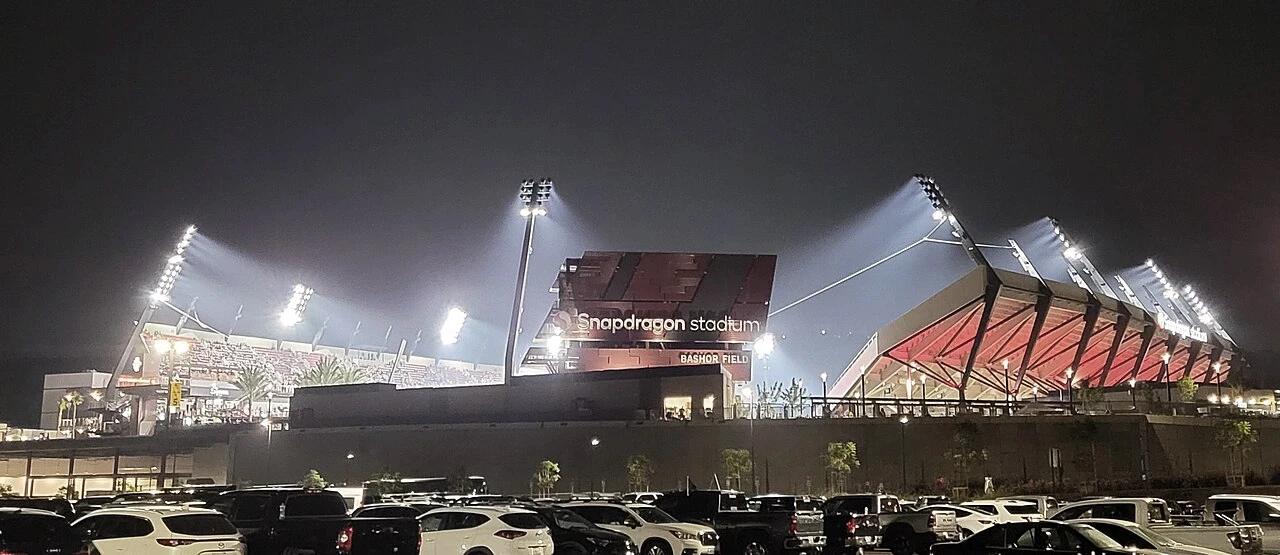
Snapdragon Stadium with Ace Parking: Event-day and dark-day coverage across surface lots under a contracted parking operator. It’s the closest structural match to a stadium footprint with a third-party lot partner.
Petco Park: A downtown ballpark environment, with mixed public right-of-way, high pedestrian density and a constrained perimeter.
Sutter Health Park: A multi-trailer deployment with a phased head-sensor configuration across distinct coverage zones.
San Diego International Airport employee lot: Continuous overnight patrol and access-controlled parking under federal-adjacent scrutiny.
Pechanga Arena: Live concert operations, including surge ingress, egress load and post-event lot dwell in an arena configuration.
What a First Season Looks Like
Phase 1: One event plus 30 dark days. Two to three assets cover your worst-covered lots. The baseline is captured, not asserted, and alert precision is proven on your property, not ours.
Phase 2: Full-season footprint. NXTSensorHub is connected to your existing camera and access infrastructure, and Nexie is in the control room.
Phase 3: Contract restructure. Guard hours are redeployed to guest-facing posts, and coverage is measured against post reduction. Bring your guard partner in during Phase 1.
Frequently Asked Questions
Do we have to replace our existing cameras or access control?
No. NXTSensorHub takes in the cameras, LPR, gate systems and access control you already own, alongside sensors NXT brings. There’s no rip-and-replace and no vendor lock on the sensing tier.
How does NXTFusion OS™ cover the post-event egress window?
Mobile autonomous assets keep covering the lots as guard staffing releases, for the 45–60 minutes guests remain. Nexie watches for pedestrian-vehicle conflict, medical events, impairment and altercations.
Does Nexie act on its own?
Under AI Assist, Nexie detects, classifies, prioritizes and drafts the incident record, and your operator decides. Under AI Orchestration it sequences the response. There’s no autonomous use of force, no autonomous vehicle contact with a person, and no identity determination without written venue policy and jurisdictional review.
What does a first deployment look like?
Phase 1 is one event plus 30 dark days, with two to three assets covering your worst-covered lots to capture a baseline. It starts with a 90-minute site walk.
Next Step
We’ll do a 90-minute site walk of your two worst-covered lots and observe one post-event egress. Then we come back with a Phase 1 scope, a baseline instrument plan and a number.